
Chowan County Court Records After Jail Arrest
After a Chowan County arrest, the jail record and the court record do related but different jobs. The Chowan County Detention Center records intake facts such as custody status, arresting agency, booking charges, release conditions, and whether the person remains in custody. The court side starts when criminal process, a complaint, an information, an indictment, or another charging document is filed and the case enters the North Carolina Judicial Branch system.
That distinction matters because Chowan County does not have an official public online jail roster, recent-booking report, active warrant search, or mugshot gallery in the official sources reviewed. Custody and booking questions should start with the sheriff or detention staff, while court records after a jail arrest should be checked through the North Carolina eCourts Portal, Chowan criminal calendars, the Clerk of Superior Court, and the Criminal Division. For current custody and booking detail, use the Chowan County jail inmate records path. Booking photos belong with the Chowan County jail mugshots process.
Process flow: arrest and booking > magistrate release conditions > prosecutor review > court case creation > Portal or calendar search > Clerk follow-up.
Find Chowan Court Records After Arrest
The main online court path is the North Carolina eCourts Portal. The Chowan County Judicial Branch hub also links the courthouse page, contact directory, court date search, criminal calendars, forms, payments, and public-record services. Portal use can be anonymous, but the site may require JavaScript, cookies, and CAPTCHA checks. Registration or sign-in may be needed for elevated access, so a public search may not show every record or image a clerk can see.
- Open the Chowan County court hub or go straight to the eCourts Portal.
- Use Smart Search for case records, or Search Hearings when the main need is a court date.
- Search by defendant name, case number, citation number, or other available case detail when known.
- Compare each listed charge with the booking charge, then review current status, hearing dates, and disposition fields.
- If the Portal is unclear, call the Chowan Clerk of Superior Court or Criminal Division for routing.
The Chowan criminal calendars are useful when a person has a pending criminal session but the full case view is hard to reach. For copies, sealed-file questions, or older matters, use the Judicial Branch public-record request service or contact the local clerk. A statewide criminal-background check is a different tool from a Chowan County court records after arrest search, and the Judicial Branch treats that request through its own background-check process.
The eCourts Portal landing page in the research manifest shows the public controls used for Chowan court records after arrest lookups at the North Carolina eCourts Portal.
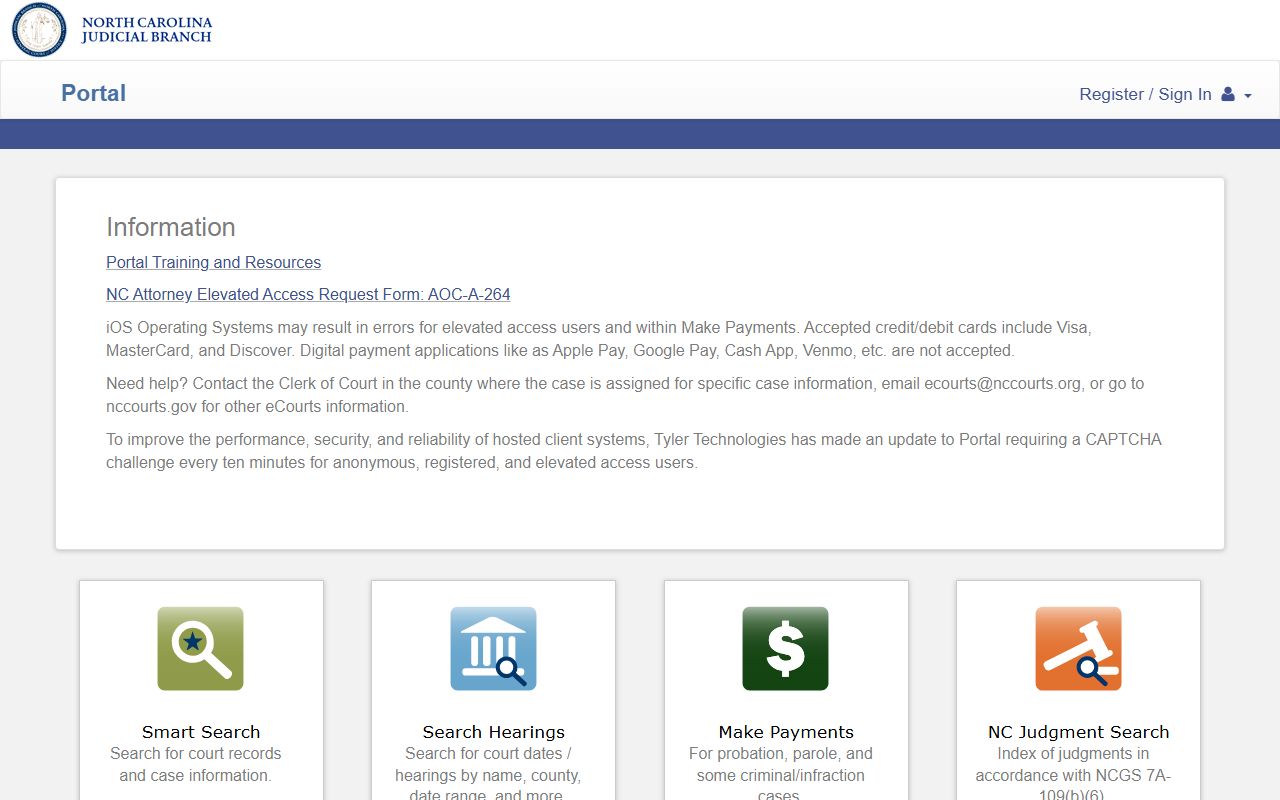
Those controls are court tools, not jail tools. They help locate charges and hearings after a case is created, but they do not replace a sheriff or detention inquiry for live custody.
Chowan County Court Search Controls
Because the Portal is a court system, it is best used for filed cases, court dates, payments, and judgment searches. It should not be treated as a current inmate roster. A person may be booked before a case appears online, and a case may remain online after a person has bonded out, been released, or transferred.
| Control | Type | Use for Chowan cases | Notes |
|---|---|---|---|
| Smart Search | Portal search tool | Case records and case information | Search criteria are entered inside the JavaScript portal. |
| Search Hearings | Portal search tool | Court dates and hearing events | Useful with name, county, date range, or case detail. |
| Make Payments | Portal payment tool | Eligible criminal, infraction, probation, or parole payments | Requires case or payment information. |
| NC Judgment Search | Judgment index | Judgment searches under state court indexing rules | Separate from custody and jail booking status. |
| Register / Sign In | Account controls | Optional public account or elevated access | Anonymous use exists, but CAPTCHA is expected. |
| Browser notices | System requirements | Portal access support | JavaScript and cookies must be enabled. |
Chowan court contacts are part of the fallback chain. The Chowan court contact directory lists the Clerk of Superior Court at (252) 368-5000, the Criminal Division at (252) 368-5002, and magistrates at (252) 368-5019. Magistrates matter early because release conditions and initial process often start there.
Chowan County Arrest Court Filings
A booking charge is not always the final court charge. The arresting officer may book a person on a warrant charge, an arrest charge, or magistrate paperwork. The District Attorney's Office for Prosecutorial District 1, led by DA Jeff Cruden according to the North Carolina Conference of District Attorneys, decides how prosecution proceeds after review. Charges may be filed, amended, reduced, dismissed, superseded, or presented to a grand jury.
| Document | Who starts it | Typical use | What it means |
|---|---|---|---|
| Complaint | Officer, prosecutor, or judicial process | Early criminal process and many lower-level cases | States the alleged offense and starts or supports a case. |
| Information | Prosecutor | Formal prosecution where indictment is not used or is waived when allowed | Sets out the charge the state is pursuing. |
| Indictment | Grand jury | Felony and serious superior-court matters | Formal grand-jury accusation that can replace or refine earlier charges. |
Under N.C. G.S. 132-1.4, returned arrest warrants, search warrants, indictments, criminal summonses, and nontestimonial identification orders are public records unless sealed by court order. Active investigative records are treated differently. That is why a sheriff's office may not confirm every active detail, while a returned warrant or filed indictment may later be accessible through the court record.
Chowan County Court Charge Status
Charge status is the most important part of court records after a jail arrest. A person may be arrested under one allegation, then have a different charge appear after prosecutor review. The court case can also show more than one count, different offense levels, amended language, or a final disposition. Read each charge separately.
| Status | What it means | Why it matters |
|---|---|---|
| Pending | The charge has not reached a final court result. | Future hearings, release terms, or plea negotiations may still change the case. |
| Amended | The charge language, class, count, or statute has changed. | The court charge may no longer match the booking charge. |
| Reduced | The prosecution moved to a lesser charge or lower offense level. | The case may carry different penalties and record meaning. |
| Dismissed | The charge ended without a conviction on that count. | The arrest may still appear in some records unless expunction or sealing applies. |
| Disposition | The current or final court result, such as guilty, dismissed, or not guilty. | Disposition controls how the charge should be read in context. |
Note: If a Chowan case has several counts, one charge can be dismissed while another remains pending or ends in conviction.
Chowan County Arrest Bond Records
North Carolina uses conditions of pretrial release, not just a cash-bond model. N.C. G.S. 15A-533 sets the general right to pretrial release in noncapital cases, with exceptions and presumptions for certain serious circumstances. N.C. G.S. 15A-534 describes how a judicial official sets release conditions. In Chowan County, magistrates are a key early contact for release paperwork and warrants.
| Release type | How it works | What to ask |
|---|---|---|
| Written promise | The defendant signs a promise to appear in court. | Confirm the next hearing date and any conditions. |
| Unsecured bond | No money is paid up front, but money may be owed after failure to appear. | Ask what conduct or court-date terms apply. |
| Secured bond | Money, property, or surety backs release. | Ask where payment is accepted and whether a hold remains. |
| Custody release | A person or organization agrees to supervise the defendant. | Confirm who can serve as custodian. |
| No-bond hold | Release is blocked until a judge, order, or outside hold changes. | Ask whether another county, state, federal, probation, or ICE hold exists. |
The court record may show bond or hearing action, but detention staff or magistrates may have the most current release status. Always ask whether a detainer remains after local bond is posted. A detainer is a hold from another agency, and it can keep a person in custody even when the Chowan bond issue is resolved.
Chowan County Warrant Arrest Records
No official public Chowan active-warrant search was found on the sheriff website. Warrant questions should use official channels: the Sheriff's Office main line, Civil Process, the Criminal Division, magistrates, the Clerk of Superior Court, and eCourts where a related case or hearing exists. The sheriff app is marketed for tips, public-safety news, and crime reporting, but the store listings reviewed did not advertise a warrant search or jail roster.
Returned warrants are different from active investigative information. A returned arrest or search warrant may become a public court record unless sealed, while active law-enforcement intelligence can be restricted. A person checking their own warrant status should contact the Clerk, magistrate, or an attorney before appearing in person, because confirmation of a warrant can lead to arrest.
Charges vs Convictions
An arrest charge is an allegation. A conviction is a court result after a plea, verdict, or other adjudication. Court records after a Chowan County jail arrest may show both, but they do not mean the same thing. This difference is essential when reading Portal results, calendars, background-check material, and old criminal files.
| Point | Charge | Conviction |
|---|---|---|
| Stage | Accusation filed or pursued in court | Final or adjudicated finding of guilt |
| Proof level | Based on probable cause or charging decision | Based on plea or proof beyond a reasonable doubt |
| Can change | May be amended, reduced, added, or dismissed | May later be appealed, corrected, or expunged if eligible |
| How to read it | Do not treat as proof of guilt | Read with sentence, disposition, and later case action |
Chowan County Sealed Court Records
Some court records after a Chowan arrest may be restricted. Juvenile matters, sealed charges, confidential investigative details, medical or mental-health data, protected identifiers, and safety-sensitive information may be withheld or redacted. A dismissal does not automatically erase every trace of an arrest in every system. Expunction is the court process often used to remove eligible records from public access.
| Point | Sealed | Expunged |
|---|---|---|
| Public view | Hidden or restricted by court order | Removed from public access under statutory rules |
| Record existence | Still exists, but access is limited | Treated as removed for many public-record purposes |
| Who may see it | Limited agencies or parties may retain access | Access is narrower and depends on the order and law |
| How it starts | Court order or confidentiality rule | Eligible petition and court order |
For certified copies, older files, or expunction questions, use the local clerk or the Judicial Branch public-record route. The Judicial Branch criminal background check page is the correct source for statewide background-check guidance, not a jail roster or custody notification tool.